
Insights — Industry Guides
Website Design for Cleaning Businesses: What to Look For
A cleaning business website needs clear services, easy booking, and proof a visitor can trust. See what to look for — with real demo examples.
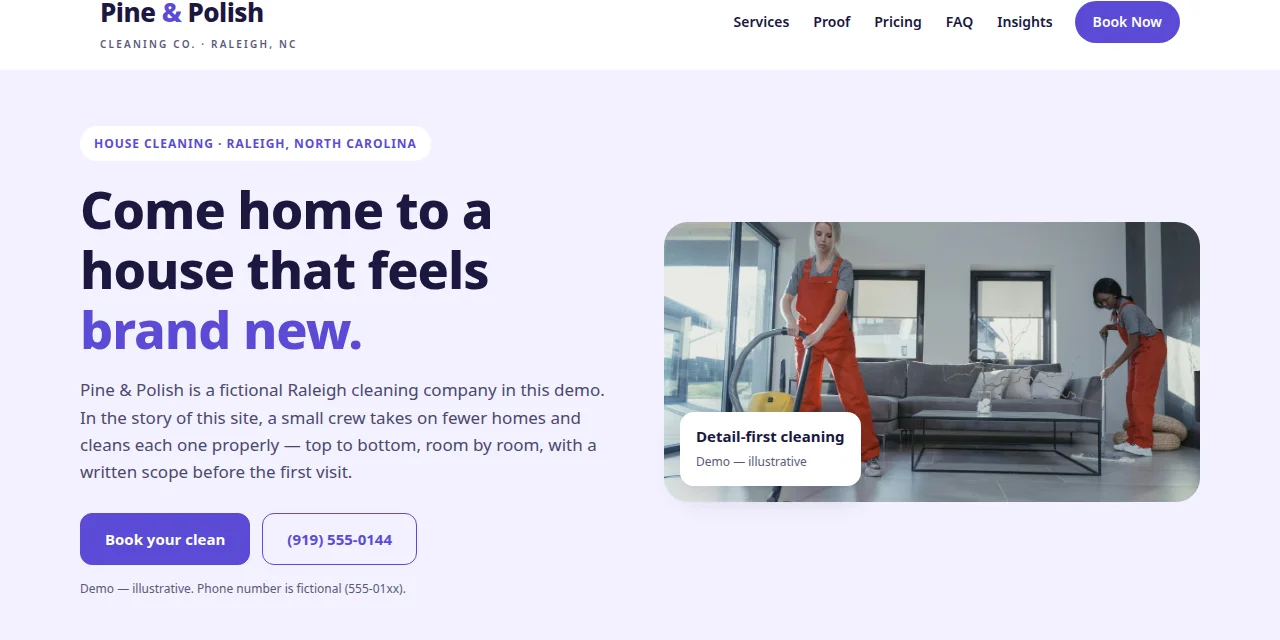
A person looking for a cleaner is not browsing. They have a dirty house, a move-out date, or an office that needs cleaning every week — and they are deciding, on their phone, who to call. Your website has about ten seconds to answer three questions: what do you clean, where do you clean it, and how do I book you?
Here is what to look for in a website that answers all three.
1. Services and prices, stated plainly
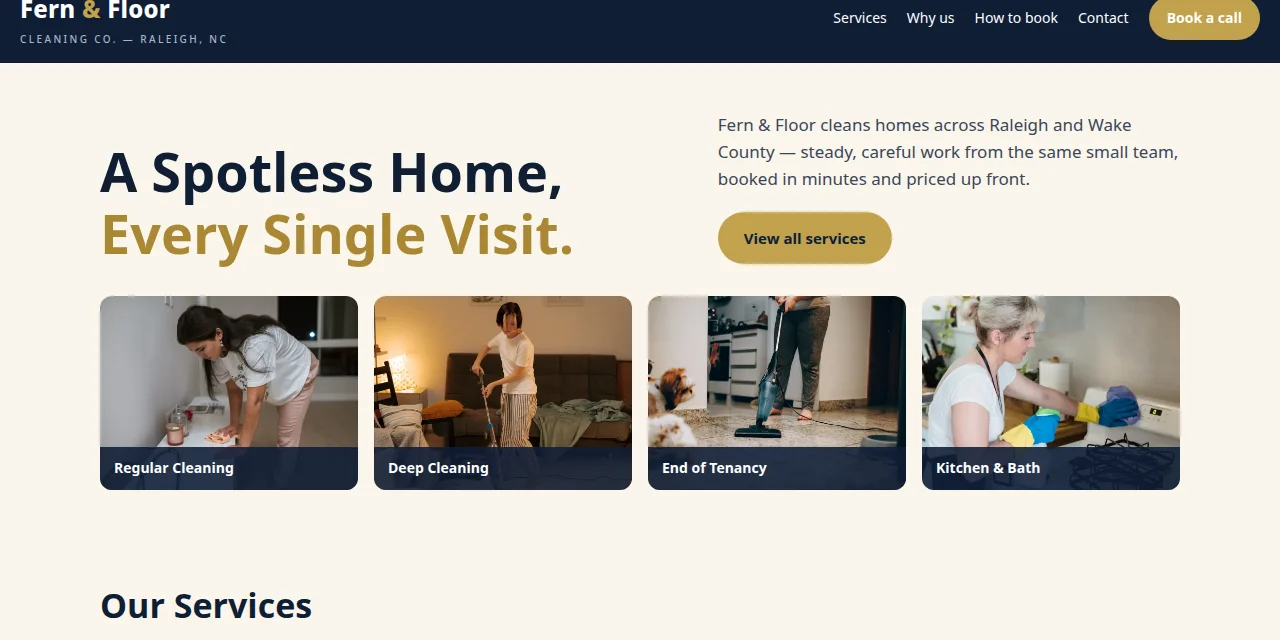
The first thing a visitor looks for is what you do — and what it costs. A services page that lists "residential cleaning" and nothing else tells them nothing. A page that lists the services, what each one includes, and a starting price lets them decide before they call.
A website that hides its prices does not get more calls. It gets fewer, because the visitor who cannot find a price moves on to the next business. Put the services and the prices where they can be seen, in words a person would actually use.
2. Booking or a quote in one tap
Most cleaning work starts with a request, not a phone call. A quote form that asks for the business name and city, the service needed, and a budget range — and takes about five minutes — is enough. The visitor should reach the form from the home page in one tap, and the form should say what happens next.
That is how our own quote works: five minutes on the form, and we reply with next steps. Your website should work the same way for your visitors. If booking takes three pages and a phone call, the website is getting in the way of the work.
3. Built for the phone first
Your visitors are on their phones — standing in the kitchen, sitting in the car, looking at the mess they want cleaned. If the site is hard to read on a phone, if the button is too small to tap, or if the text runs off the screen, they leave. A cleaning business website is a phone website first and a desktop website second. Open any site you are considering on your own phone before you judge it anywhere else.
4. Proof a visitor can trust
A cleaning business sells trust — someone is coming into a home or an office. The website has to earn that trust before the first visit. What earns it is not adjectives. It is specifics: the services, the areas served, the way booking works, and a site that looks like it was made with care.
What does not earn it is decoration. A long paragraph about "passion" says nothing. A clear list of services, a clear service area, and a working quote form say everything.
5. A service area that says where you work
"Serving the Triangle" means nothing to a person in Cary who wants to know whether you come to Cary. Name the towns. If you serve Raleigh, Durham, and Cary, say Raleigh, Durham, and Cary. A visitor who cannot tell whether you serve their town will not call to ask — they will call the business whose site says so.
See it in action: five demo examples
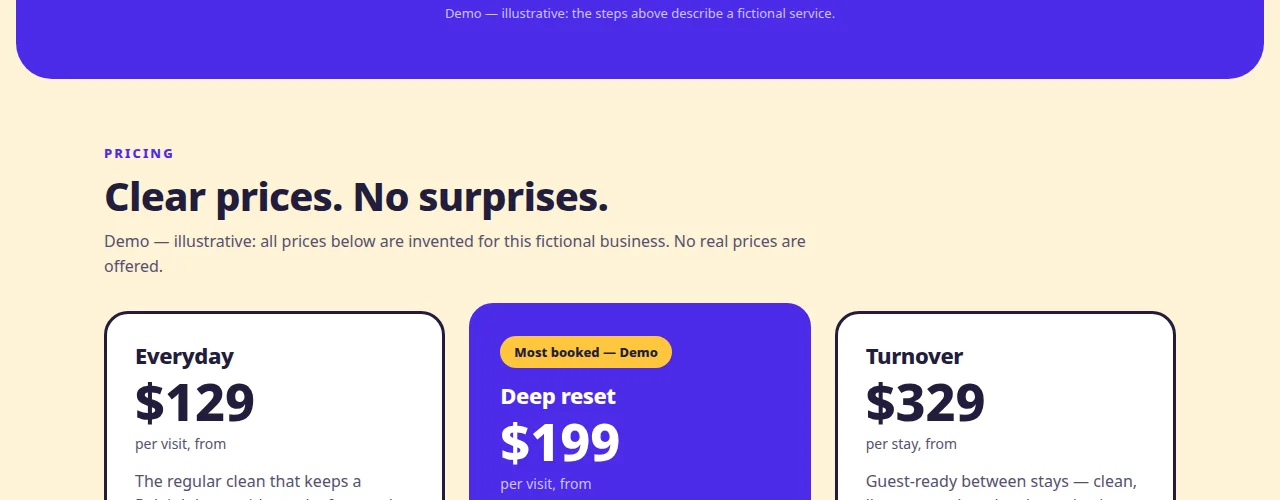
The clearest way to judge a website is to open one. These are fictional demos built by 5AM Web — Demo — illustrative: fictional examples built by 5AM Web, not real businesses — made to show what a cleaning business website can look like. Open them on your phone:
- Fern & Pine — a cleaning business demo
- Fern & Floor — a cleaning business demo
- BrightNest — a cleaning business demo
- Pine & Polish — a cleaning business demo
- Tidy Oak — a cleaning business demo
Look at each one the way a visitor would: can you tell what the business does in ten seconds? Can you find the services and the prices? Can you request a quote in a minute? If the answer is yes, the website is doing its job.
What about an HVAC business website?
The same five things apply — with two additions that come from the work itself.
First, service calls and urgency. A person with no heat in January is not browsing. They need to know, fast, whether you take emergency calls, what areas you cover, and how to reach you. The phone number and the service area belong at the top of the page, not at the bottom.
Second, seasons. Heating in winter, cooling in summer, maintenance in between. A website that speaks to the season the visitor is in — instead of the same generic page all year — reads like it was written by someone who does the work.
One honest note: we have not built demo examples for HVAC businesses yet. The cleaning demos above show the approach — clear services, easy booking, phone-first — but they are cleaning demos, not HVAC demos. We do not pretend otherwise.
What about a painting business website?
Again, the same five things — with one addition of its own: pictures of the work.
A painting business is judged by what it has painted. A website for one should show the work: rooms, exteriors, finishes, colours — real photos of finished jobs, not stock pictures of paint cans. Before-and-after photos, where the business has them, do more than any paragraph.
The rest is the same: services and prices stated plainly, a quote in one tap, a service area named town by town, and a site that works on a phone. And the same honest note as above: we have not built demo examples for painting businesses yet. The cleaning demos show the structure; the painting examples do not exist yet.
What a good proposal looks like
Whether the website is for cleaning, HVAC, or painting, the proposal should look the same: written, with an exact price, a list of what is included, and what happens after launch — before anything is paid. At 5AM Web, a website starts at $1,800 for design, $2,880 for design and build, and $3,960 with branding included, and the exact price for your business comes in the proposal. You see it first, then decide. No payment upfront.
If you want to know what yours would cost, request a quote or book a free consultation. And if you want to see what a website for your kind of business can look like, open the demos above — that is what they are there for.
Next steps
The proposal tells you exactly what your website would cost and what it would include — before anything is paid.
Next step — Get a quote
Know what yours would cost?
Tell us about your business and we reply with a detailed written proposal — before anything is paid.